Our Solution
The Device: Appearance
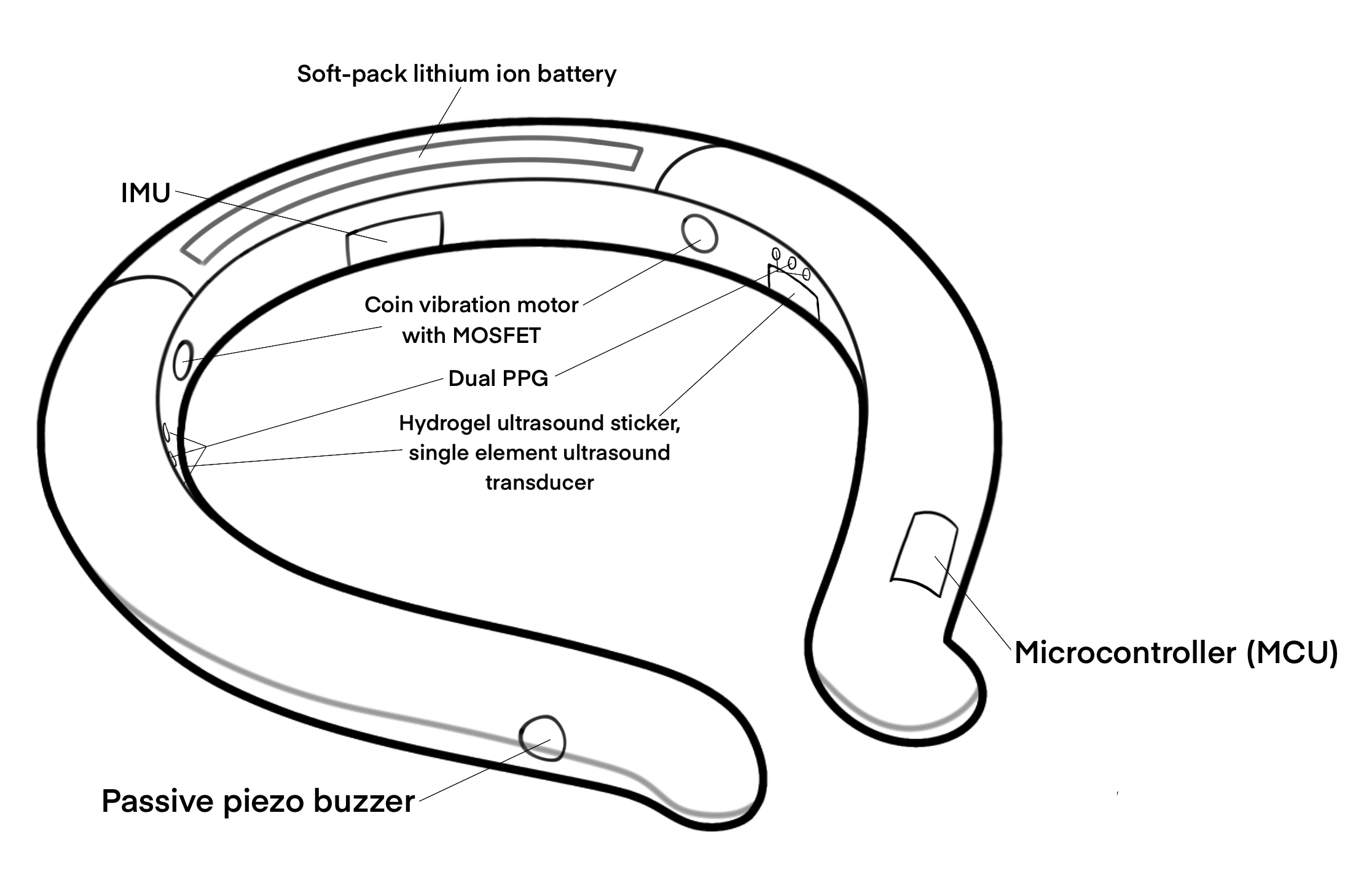
NeuralShield is a slim, U-shaped neckband that rests comfortably at the base of the neck, making it a low-profile wellness accessory. A rigid inner spine helps the band maintain its shape, keeping the sensing modules stably positioned against the skin. The structure is encapsulated in medical-grade silicone to improve comfort and skin safety for 24/7 wear. Along the inner surface, a soft hydrogel ultrasound sticker provides consistent acoustic contact, and nearby optical contact points support reliable light coupling. The overall look is intentionally discreet and non-medical, encouraging adoption and reducing stigma.

The Device: How it Works
NeuralShield’s core components match the modules labeled in the diagram. A single-element Doppler ultrasound transducer, paired with the hydrogel ultrasound sticker, continuously measures carotid blood-flow dynamics (e.g., velocity and turbulence) when the device is properly seated. An integrated dual PPG unit (with green, red, and infrared light, photodiodes, and the necessary analog front-end circuitry) tracks pulse-wave features and oxygenation trends. An IMU—a 3-axis accelerometer and 3-axis gyroscope (activated primarily during movement)—captures neck motion, enabling the system to distinguish true physiological shifts from motion artifacts. A low-power microcontroller (MCU) coordinates sampling, performs basic filtering and feature extraction, and prepares the signal summary for transmission to the phone.
The Mobile App
Whenever NeuralShield’s on-device logic detects an abnormal pattern—such as a sustained shift in flow features or pulse-wave morphology beyond what motion alone can explain—it connects a smartphone via Bluetooth Low Energy and opens the companion app. The app is designed to be ready before an emergency: the patient first completes a short medical profile, then follows a brief tutorial that records their baseline speech and facial movement while they reads a simple line of text into the camera. If NeuralShield later detects concerning signals, the app wakes the patient and guides him through a rapid confirmation sequence: a few quick, easy checks of arm function, balance, and posture symmetry, along with how he feels in that moment. If the combined evidence suggests high risk, the app prompts immediate action by connecting to emergency services and notifying the patient’s preset contacts—helping move him from “something feels off” to “help is on the way” in under a minute.